
Maha Shivratri at Maha Kumbh 2025: The Grand Conclusion
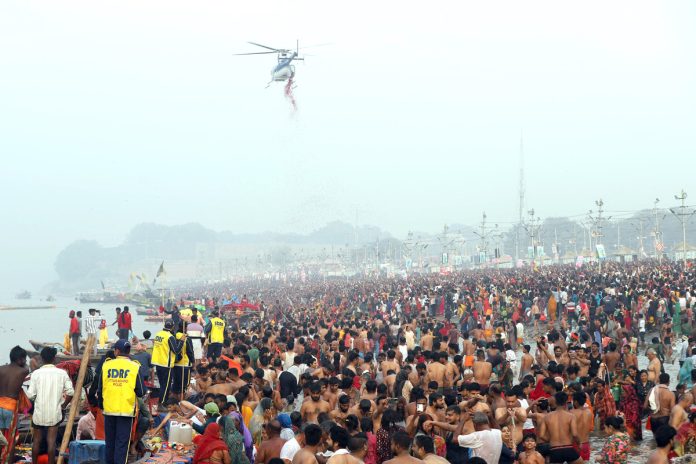
The final day of the grand Maha Kumbh Mela 2025 commenced on Wednesday, February 26, with thousands of devotees making their way to the Triveni Sangam in the early hours for a sacred dip—the last special ‘snan’—on the occasion of Maha Shivratri.
This marks the conclusion of the six-week-long Maha Kumbh Mela, the world’s largest spiritual gathering, held in Prayagraj, Uttar Pradesh.
Significance of Maha Shivratri in Maha Kumbh
Maha Shivratri is a key Hindu festival, commemorating the divine union of Lord Shiva and Goddess Parvati. In the context of the Maha Kumbh, it holds added significance. According to Hindu mythology, during the Samudra Manthan (churning of the ocean), Lord Shiva played a crucial role, leading to the emergence of the Amrit Kumbh (pitcher of nectar), which is the essence of the Kumbh Mela.
Key Rituals and Special Baths
The Maha Kumbh Mela, which began on January 13, featured six special ‘snan’ (baths), including three ‘Amrit Snan’ days:
- Paush Purnima (January 13)
- Makar Sankranti (January 14)
- Mauni Amavasya (January 29)
- Basant Panchami (February 3)
- Maghi Purnima (February 12)
- Maha Shivratri (February 26)
Maha Shivratri 2025: Key Highlights
- In the early hours of Wednesday, devotees rushed towards the Triveni Sangam, where the Ganga, Yamuna, and Saraswati rivers converge, for the final sacred bath of the Maha Kumbh Mela.
- To accommodate the anticipated high influx of devotees, the entire Kumbh Mela area was declared a ‘no vehicle zone.’ Additionally, DIG (Kumbh) Vaibhav Krishna announced that no VIP privileges would be granted on this day.
- The Uttar Pradesh government issued a detailed advisory, guiding devotees to designated ghats based on their entry points. Those coming via the Uttar Jhunsi route were directed to Harishchandra Ghat and Old GT Ghat, while those from Dakshini Jhunsi were advised to use Arail Ghat. Devotees entering from the Pande area were encouraged to take a ‘snan’ at Bharadwaj Ghat, Nagavasuki Ghat, Mori Ghat, Kali Ghat, Ram Ghat, and Hanuman Ghat.
- Elaborate security arrangements were put in place, with officials expecting a turnout higher than the 1.33 crore devotees seen on Tuesday. Security measures included the deployment of 37,000 police personnel, 14,000 home guards, 2,750 AI-based CCTV cameras, three Jal Police stations, 18 Jal Police control rooms, and 50 watch towers.
- Authorities monitored social media 24/7 to prevent the spread of misinformation regarding the Maha Kumbh Mela.
- Indian Railways made special arrangements for Maha Shivratri, scheduling over 350 additional trains from Prayagraj to facilitate the return of devotees after the final ‘Amrit Snan.’ Previously, during Mauni Amavasya, more than 360 special trains were deployed, transporting over 20 lakh passengers safely.
- In light of past stampede incidents, North Central Railway, North Eastern Railway, and Northern Railways were placed on high alert. Special measures included the deployment of additional personnel at key stations. Jhunsi station saw 850 RPF personnel and 290 commercial staff, while Prayagraj Rambagh had 500 RPF personnel and 250 commercial staff on duty.
- Union Railway Minister Ashwini Vaishnaw personally oversaw operations, alongside Railway Board Chairman and CEO Satish Kumar. General managers from three railway zones coordinated efforts to manage the surge in passengers.
- Due to previous fire incidents, fire safety was also a top priority. 50 fire stations and 20 fire posts were kept on standby, as confirmed by Chief Fire Officer Pramod Sharma.
- Chief Minister Yogi Adityanath extended greetings to devotees across India and beyond. He emphasized that Maha Shivratri inspires people to work for societal welfare and strengthens national unity. He highlighted that the Jyotirlingas across India stand as symbols of national integration.
With Maha Shivratri marking the grand culmination of the Maha Kumbh Mela 2025, the festival once again reaffirmed its significance as a confluence of faith, tradition, and spirituality.